

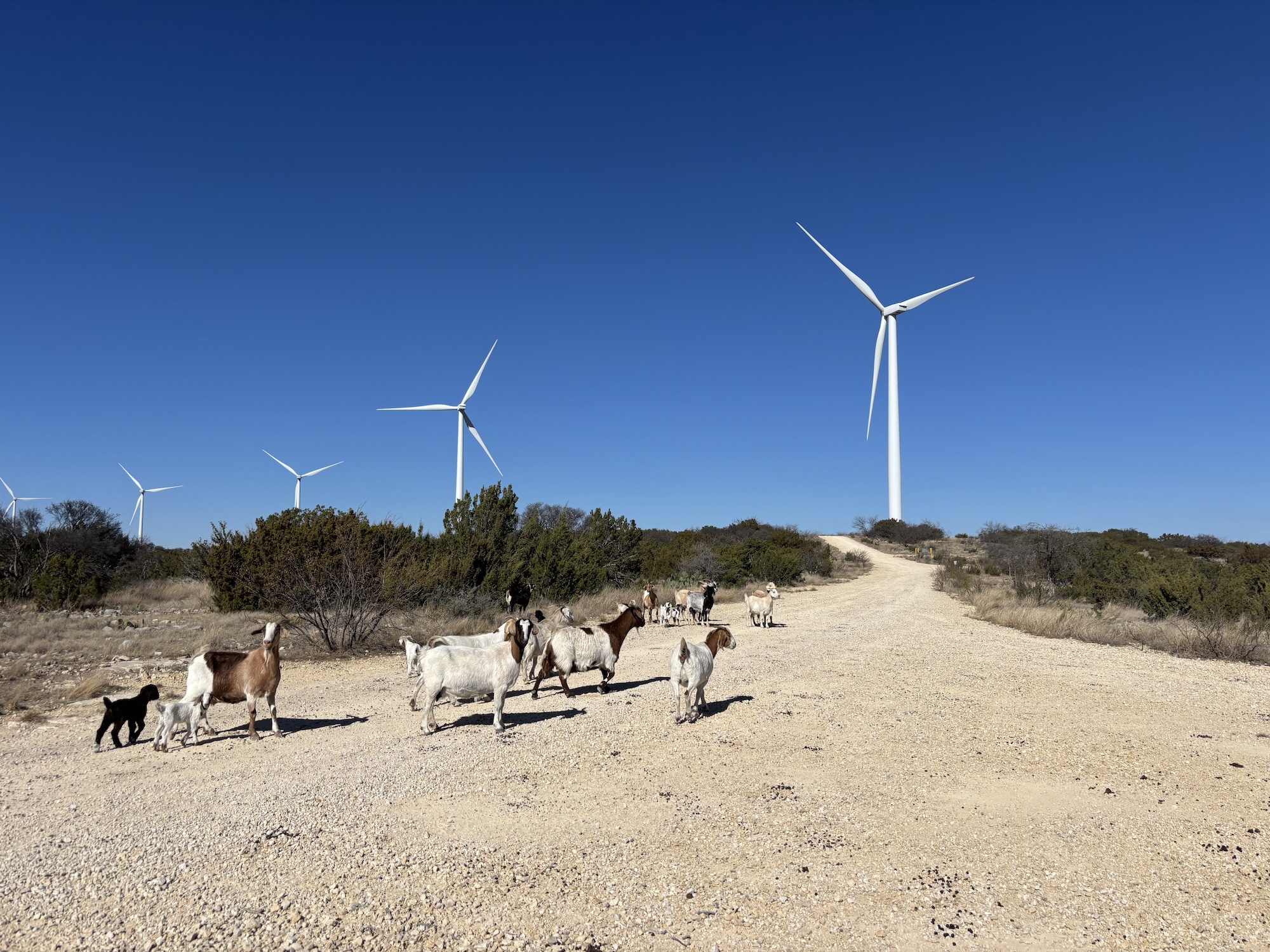
On an unseasonably warm January day, Duff Hallman’s goats and sheep wandered unhurried through the rocky hills of his ranch 30 miles south of San Angelo, Texas, unbothered by the long shadows that swept over the ground. The shadows fell from wind turbines towering 250 feet above, their blades spinning like clock hands over land that has been in Hallman’s family for four generations. From a shady spot in his backyard, Hallman can almost nod off watching them turn. “It slows your pace down a bit,” he said.
At 74, Hallman still feels honored to work the 9,200-acre ranch he owns with his brother and sister, sometimes putting in as much as 15 hours a day. The labor starts at dawn — mending fences, clearing pastures, tending horses and livestock — and is far from lucrative. He doesn’t do it for the money, but out of gratitude to those who kept the ranch going before him. “Somebody worked their tail off to make it happen,” he said. “And I have worked my tail off, too.”
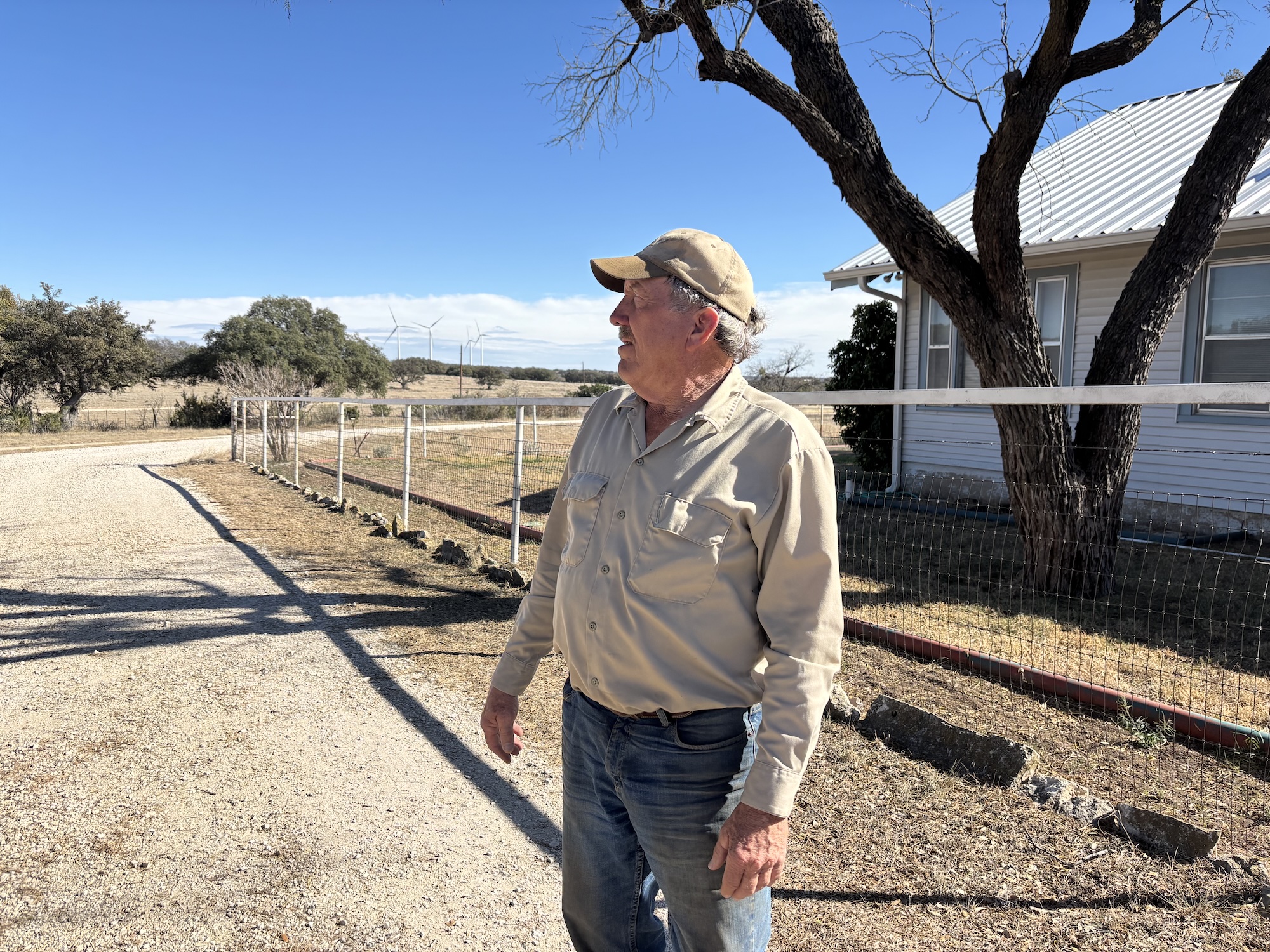
Standing beneath a live oak, his ballcap shielding tired eyes, Hallman spoke of bluebonnets that carpet the pastures each spring and moonrises that “knock your socks off” — one so bright he thought it was a spaceship. His great-grandfather Sam Henderson, a Texas Ranger, bought the land in 1916; it straddles Tom Green, Schleicher, and Irion counties about four hours west of Austin. Hallman spent his childhood summers there, learning his way around.
He took over after his grandparents died in 1975 and set to work — rebuilding pens and corrals, cutting cedar and mesquite, tending livestock. In the early 1980s, an oil company drilled 15 wells, and the Hallman siblings prospered. “That was a good time,” he said. “They were trying to get it out of the ground as fast as they could.”
But within a decade, the oil began drying up and federal wool subsidies vanished. Suddenly the ranch felt fragile. They needed a new revenue stream — something that might soften the hard years and help keep their children on the land after them — and in 2007, they signed a lease with a clean energy company. They hadn’t even heard of wind rights when the landman called. “We just thought the wind blew across the surface,” Hallman said.
For roughly six months, workers uprooted stones, bushes, and trees; carved 53 miles of road through the hills; and poured concrete slabs for 33 steel towers. The land thrummed with constant motion and dust choked the air. As Hallman watched his ranch transform, he worried that he’d made a mistake.
Little did he know, he had glimpsed the future.
Laura Mallonee / Grist
Hallman’s doubts reflect a larger reckoning underway in West Texas. Over the past two decades, rural counties that helped meet the nation’s demand for oil have become unexpected linchpins of its clean-energy buildout. Pumpjacks now stand alongside wind and solar farms drawn in part by open range and generous federal incentives. For Schleicher County, where oil production has waned and the tax base dwindled, “renewables” have taken on a double meaning, offering the promise of fiscal stability in a place desperate for economic rejuvenation. But that promise is now complicated by the Trump administration’s rollback of clean energy policy and many of the incentives that fueled the boom.
Texas has been one of the biggest beneficiaries of the Inflation Reduction Act, or IRA. During the three years after the legislation passed in 2022, developers invested some $62 billion in clean energy ventures statewide and announced billions more in planned construction. Projects already constructed or proposed in Schleicher County — including a hydrogen facility once estimated to bring $1.2 billion in tax revenue — were forecast to generate tens of millions for schools, hospitals, and other services.
But those projections rested on one key assumption: The federal tax credits at the heart of the IRA would remain in place. The law expanded and extended earlier incentives through 2024 and established a new system of credits to begin in 2025. This federal support — including additional incentives for installations built in low-income communities and regions with a history of fossil fuel extraction — could cover up to 70 percent of a facility’s cost.
Before the cuts, governments and landowners across Texas stood to collect nearly $50 billion in lease payments and tax revenue from current and planned projects, according to one report, with roughly three-quarters of counties positioned to benefit. Now, many of these developments — and their hoped-for revenue — face a precarious future. More than $4 billion in investment has already been threatened or cancelled. All told, the about-face could eliminate thousands of jobs and shave $20 billion from the state’s gross domestic product by 2035. The climate consequences are equally stark, adding roughly 83 million metric tons of carbon emissions to the atmosphere by some estimates.
One county illustrates what has been gained by the boom — and what could be lost with its passing. Scurry County, about two hours northwest of Hallman’s ranch, is one of the largest producers of renewable power in West Texas. Companies have built roughly a dozen wind and solar farms, with a total capacity of about 2,300 megawatts of power; they are projected to generate nearly $1 billion for the county and local landowners over the facilities’ lifetimes.
County Judge Dan Hicks said clean energy helped stabilize a budget long whipsawed by volatile oil and gas revenues. Some years, without a steady income stream, local officials faced the prospect of closing the library, the youth center, and the golf course. Renewables helped change that. Abatement agreements with developers created reliable, long-term payments that don’t fluctuate with the market or vanish when a manufacturer leaves town, Hicks said. Jobs have been slower to follow, but a support industry is beginning to take shape around the installations. “When your population is 17,000, every job counts,” he said. Eventually, he said, “I’d love to see us become the energy capital of Texas.”
He doesn’t think new wind and solar will come without federal incentives. Yet Joshua Rhodes, an energy researcher at the University of Texas who has studied the IRA’s impact in Texas, anticipates development continuing — albeit more slowly, and at greater cost. That likely means pricier electricity and slimmer returns for rural counties hoping to share in the growth. How much of it will materialize now is uncertain.
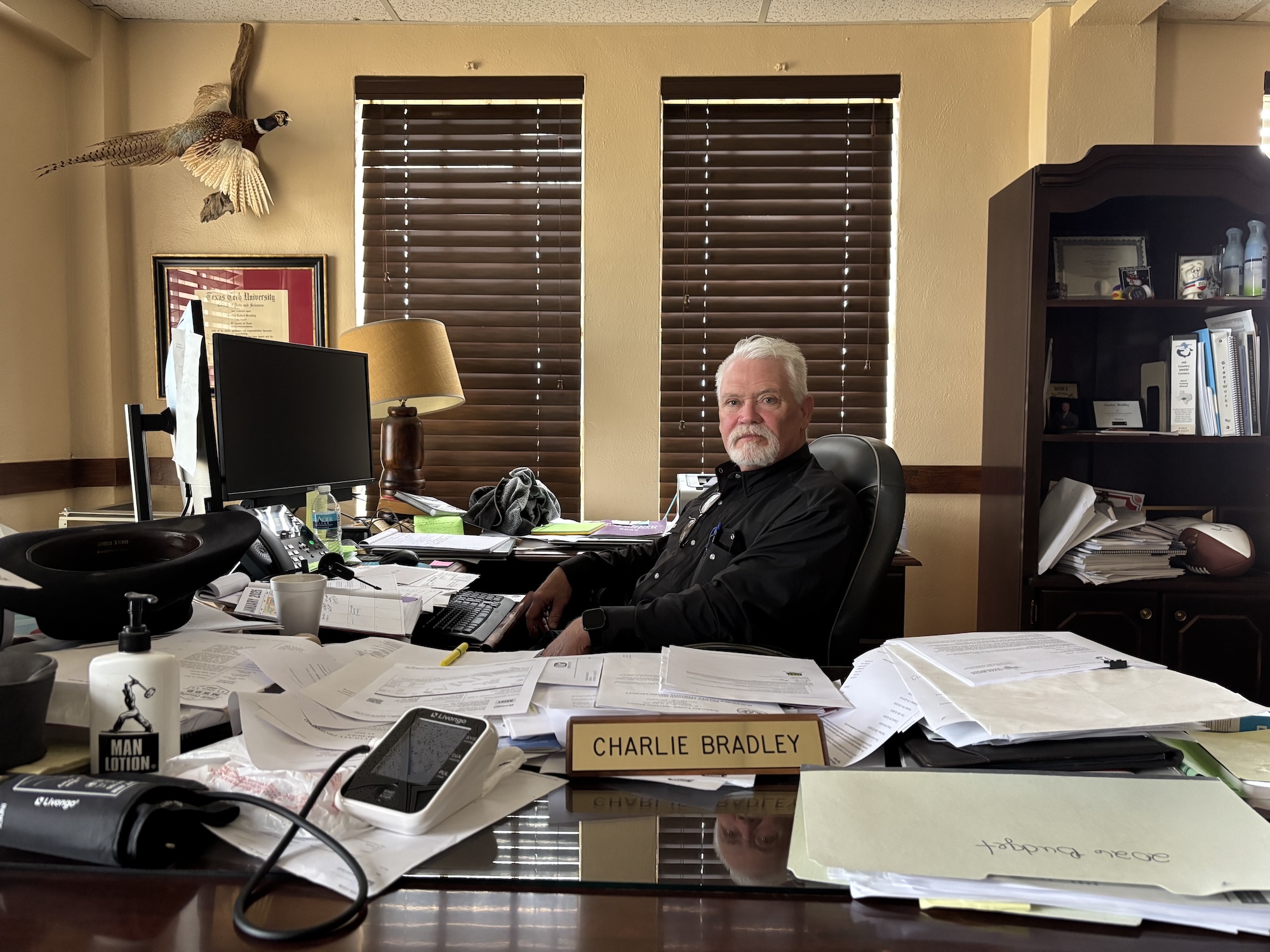
Schleicher County Judge Charlie Bradley looks out the window of his cluttered second-floor office in Eldorado, the sand-colored farming town he’s known all his life. The old filling station on the corner, where he pumped gas in high school, has closed. So has the wool warehouse a few blocks south, where he helped process yarn in middle school.
Just north of the courthouse, the yellow-brick elementary school shows its age. Water pools in the basement and leaks through the ceiling, and, as one teacher said, “a lot of the rooms stink.” At lunchtime, kids from the high school next door spill into the surrounding neighborhood, a mix of small houses and mobile homes. A washing machine rusts on one porch. Yards collect trailers, cars, and piles of brush, though many assert pride with Texas stars, decorative windmills, and Christmas lights still twinkling in January.
Bradley grew up here in the 1960s and ’70s, when Eldorado was prosperous enough to support several family-owned groceries, stores, and restaurants. He set out for Texas Tech University and dabbled in six subjects before settling on photography. (“Best seven years of my life,” he said.) After returning home, he ran a portrait studio for a decade, then spent another 10 years chasing storms as an insurance adjuster. He was in the middle of one in 2007 when the retiring county judge called to suggest he run for the job. Bradley said he didn’t know a thing about governing. “Well hell, Bradley,” the judge replied, “Nobody does. If they did, they wouldn’t run.’”
Laura Mallonee / Grist
By the time Bradley took office in 2009, the county was reeling from the decline of the fossil fuel and sheep industries. Then came fresh blows. A fundamentalist Mormon sect that was the county’s fourth-largest taxpayer was prosecuted for child marriage and lost its property in 2014, putting a sizeable dent in revenue. The next year, the Baker Hughes oilfield services yard — which employed about 80 people — shut down. With property taxes already near the legal ceiling, Bradley had to trim about $300,000 from the budget, hitting roads, bridges, and a meals program for the elderly. Much of what remained of the fossil fuel economy eventually left, too, though a Kinder Morgan gas pipeline announced in 2019 has boosted the tax base. The population has fallen from roughly 3,500 in 2010 to about 2,300 in 2024.
Today, the county runs on $9.3 million. Things are so tight there are just two workers to cut all of its grass, and Bradley has been known to climb on a mower to help out. “It’s real relaxing,” he said. “You can’t hear the phones.”
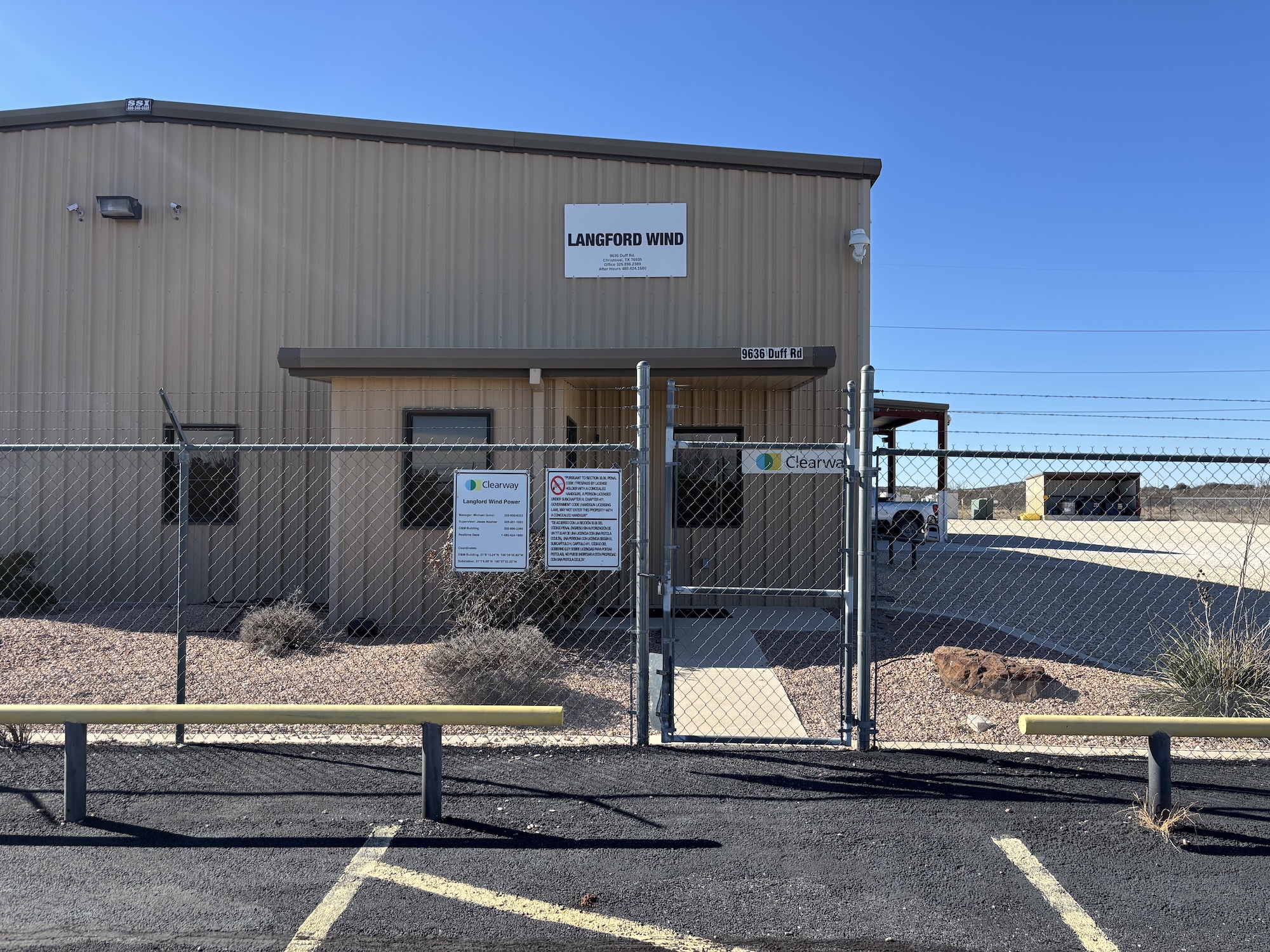
Renewable energy has provided a modest lift. The 160-megawatt Langford wind farm, which stretches into Schleicher County from an adjoining county, came online the same year Bradley took office, offering a bit of relief amid the losses; it now pays the county about $35,000 annually. The 100-megawatt Live Oak wind farm was built in 2018; in just the past six years, it has contributed nearly $16 million in taxes to local governments, including $7.2 million to Bradley’s budget. A 430-megawatt solar farm rising nearby could add about $225,000 to his budget each year.
Laura Mallonee / Grist
Still, Bradley remains clear-eyed about green energy’s limits. Several companies have signed agreements without ever breaking ground, and those that did haven’t replaced what oil and gas once provided. The projects employ only a handful of workers — nothing like the number the oilfield service yards and gas plants once did.
The modest financial gains have come with friction. Some ranchers, tired of what Bradley called “scraping out a living on six inches of topsoil and rock,” want the money clean energy developers pay to lease their land. They also hope the revenue might help Schleicher County avoid the fate of neighboring Menard County, one of the state’s poorest. Others resent having their tax dollars spent on federal incentives for what they call “alternative energy.” Bradley said he has been asked, “Why in the hell do we want all that stuff? This is ranching land, and it’s always been ranching land.”
The flashpoint came in 2023, when ETFuels began leasing rights for a 500-megawatt wind, solar, and battery complex that would also produce hydrogen to make methanol for shipping — a larger and more complex industrial endeavor than anything Schleicher County had seen before. For many residents, the problem wasn’t the size, but the water. The plant would draw from the Edwards-Trinity Aquifer, the county’s only source, and no one could say how much could be spared. The first exploratory wells came up dry; later ones struck water. The question filled the civic center with tense, packed meetings. But under state law, Bradley had no ability to intervene in the landowner’s drilling. “I can’t tell him what to do with his land,” he said.
ETFuels never broke ground, but something even bigger emerged. In December of 2024, Apex Clean Energy pitched a wind, sun, battery, and “green” hydrogen facility that would produce enough energy to power 700,000 homes and create 90 full-time jobs. This time, the water would come from another county. A presentation outlining the benefits left school board members speechless: The operation would provide as much as $1.2 billion in property tax revenue over 25 years, including $20 million a year for the school district, enough for a new elementary school. In November, the board put a bond package to voters, hoping the Apex project would pay for it. (The measure ultimately failed.)
Apex appears to have scuttled plans to produce hydrogen in Schleicher County, though it’s not clear why. The company, which declined to comment, last promoted the project in June, just before President Trump signed the “One Big Beautiful Bill Act” into law. Among other things, that legislation rolled back the production tax credit of up to $3 per kilogram for clean hydrogen. Experts like Rhodes at the University of Texas doubt many such projects can be viable without it.
Bradley won’t speculate about lost or future revenue. “That egg is not in my basket,” he said. What is in his basket lies just beyond his office window: an elementary school with a leaky basement, two men mowing all of the county’s grass, and a community that’s spent decades waiting for something to take root.
IIf Bradley can see the changes that have come to Schleicher County in recent years, Sandra Pfeuffer can hear them. The sound carries across ranchland where her family once expected only the lowing of cattle.
Her father-in-law leased wind rights on his ranch in Eden, a town in neighboring Concho County, to a renewable energy company in 2008. He did so, Pfeuffer said, because he was dying, and paying estate taxes would have required selling off part of the ranch. Nothing came of the deal, but a decade later, her husband Ray signed a lease with Maverick Creek Wind Farm, which was built in 2020. “It was the worst decision we ever made,” Sandra said.
The four turbines hummed so loudly, and the transmission line buzzed so persistently, that she couldn’t sleep during visits. “I’m not going to lie — mailbox money is great,” she said. “But the mailbox money will never cover the loss of the enjoyment we had in that ranch.”
Pfeuffer is now fighting the rising tide of clean energy developments in eastern Schleicher County, where she lives. She isn’t blind to the irony of her stance. Ranches are dividing all around, she concedes, and times are changing. But she has come to see such projects not as progress but as a threat to the only life she’s wanted. “As a rancher, I feel kind of like a quail,” she said. “Everything’s after you, and it’s only a matter of time ’til you die.”
When ETFuels began drilling wells on her neighbor’s land in 2023, she led the charge against it. She worried about what might be lost beneath the surface. “My fence doesn’t go underground and separate your water from my water,” she said. “It’s wrong for my neighbors to pump half a million gallons a day and cut my water away from underneath me.” (A representative of ETFuels told the county’s water board it could use about 220,000 gallons per day.)
The next year, the Pfeuffers gathered fellow ranchers around their dining table and formed the Edwards Plateau Alliance to “counteract misleading narratives” about renewable energy. Sandra organized meetings, brought in outside critics, and pressed lawmakers to protect groundwater from hydrogen development. “[Companies] go into communities that need a lifeline and they promise the world,” she said. “The money is not worth the peace and beauty that they take away from your property.”
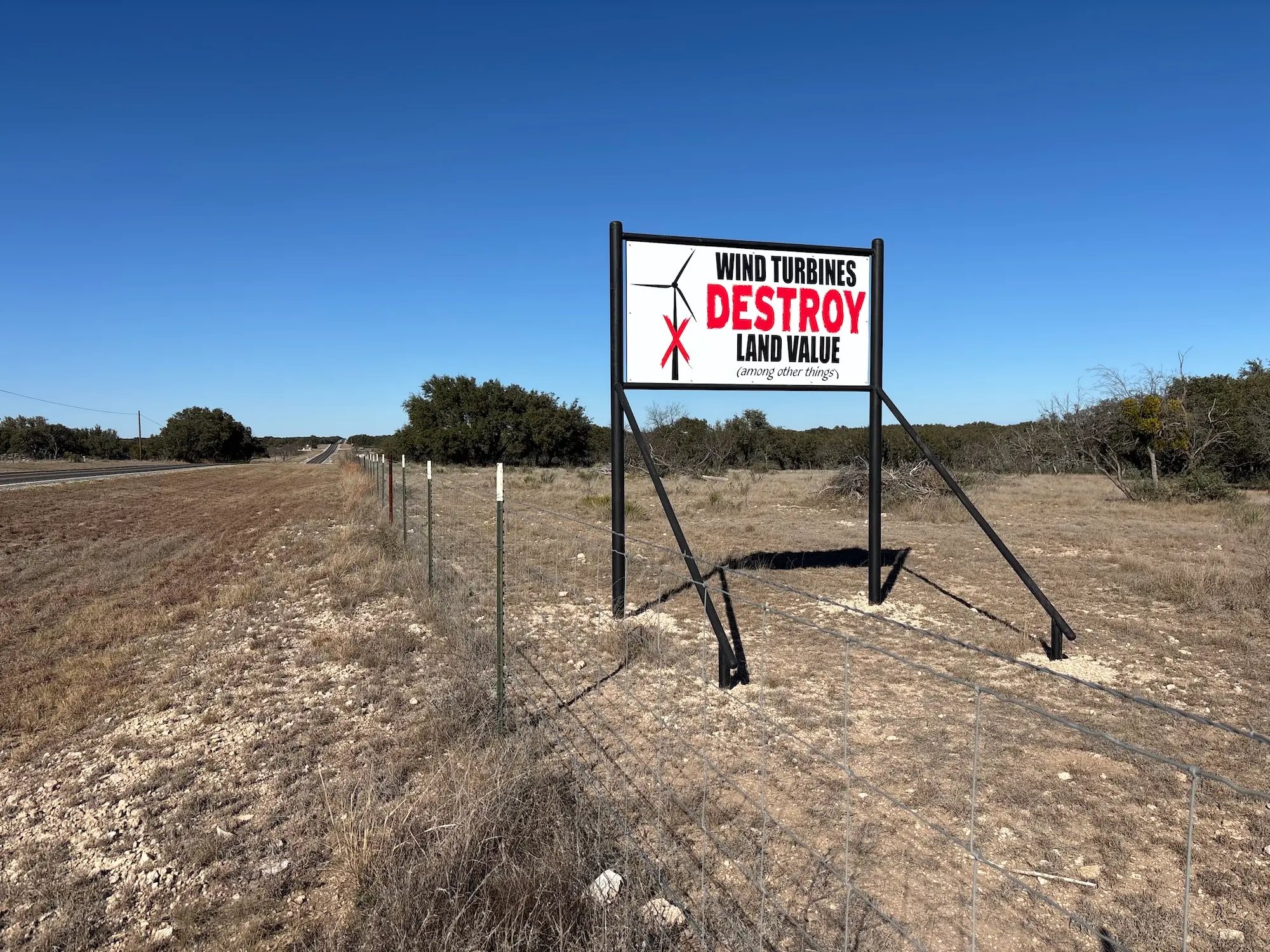
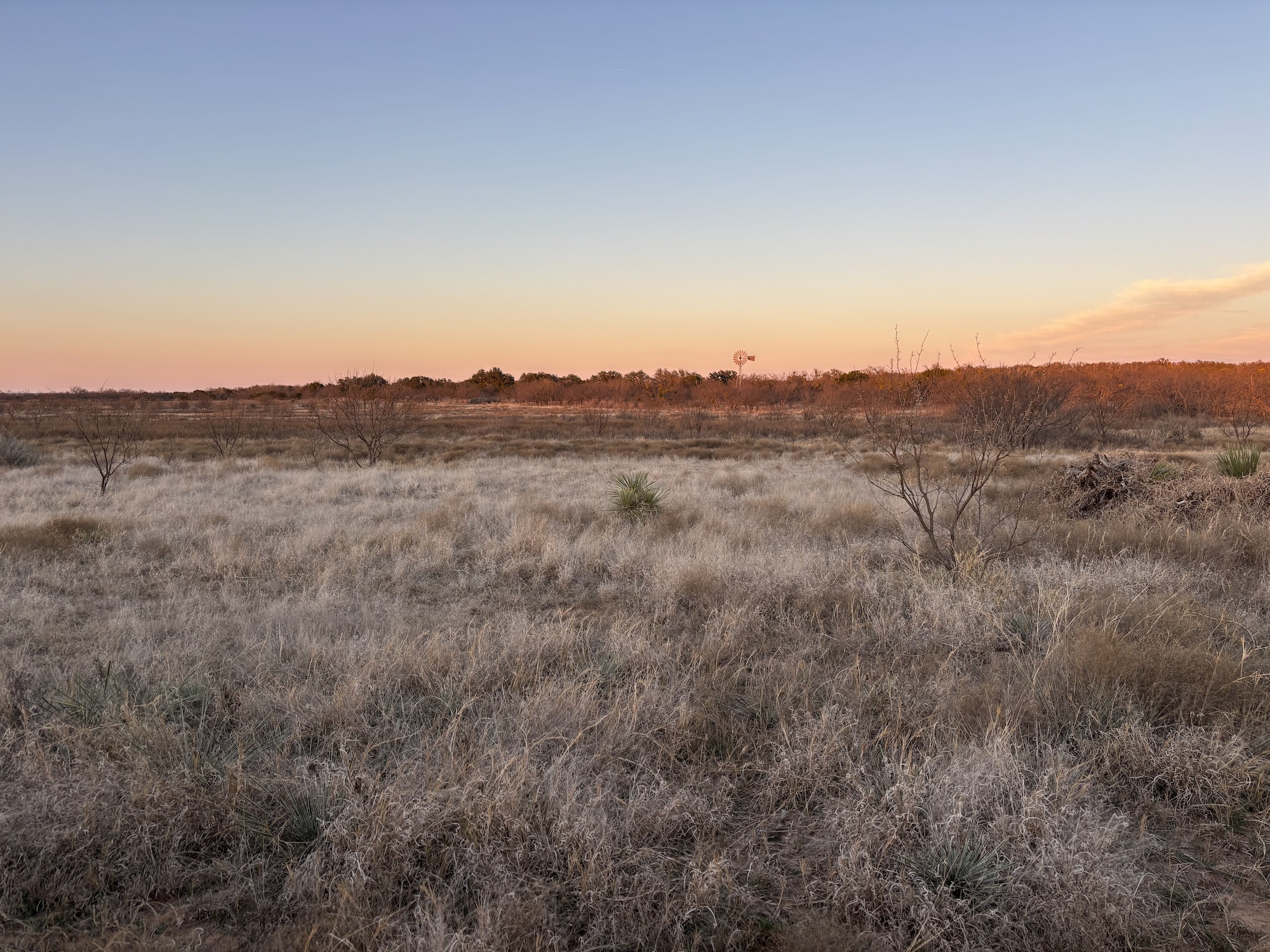
A visit to their 3,300-acre ranch shows what she believes is at stake. A few miles from the turnoff from the main road, a sign reads: “Wind Turbines Destroy Land Value.” Beyond the stately, white farmhouse and its web of gates, rocky pastures stretch wide and still, dotted with live oaks and a few oil pumpjacks. Sandra cut the engine of her all-terrain vehicle in front of one and listened. There is no whoosh or hum, only the rustle of breeze through the grass.
Laura Mallonee / Grist
The quiet helps explain why the Pfeuffers are so committed to their ranch. They have spent years clearing mesquite and cedar so grass can take hold — not just for profit, she said, but to benefit the land. The work has taught her to pay attention. “Out here, you’re so connected to everything,” Sandra said. “If there’s a rock out of place, you notice.”
She doesn’t see that kind of attentiveness in the push for renewables. To her, it’s just another extractive industry — one that will leave West Texas depleted, its water drained, and its land scarred with concrete, rebar, and fiberglass. Above all, she resents what she sees as urban priorities imposed on rural communities by people who will not live with the consequences. “I don’t come into town and knock down your buildings so I can run my cows,” she said.
The Pfeuffers’ activism has riled other ranchers. Sandra said that her neighbor no longer speaks to her. She’s heard rumors of vague threats, of people at the coffee shop saying things like, “These people who are fighting this, we know where they live.”
While the fight in West Texas plays out in sidelong glances and veiled warnings, in Austin it is reduced to charts, forecasts, and models. State planners say Texas simply doesn’t produce enough energy: Rising electricity use, driven in part by population growth and a boom in data centers across the state, are pushing demand sharply upward even as extreme weather strains the grid. The Electric Reliability Council of Texas, the nonprofit that manages power for about 90 percent of the state’s electric load, expects peak demand to climb from 85 gigawatts to 150 by 2030. To move that juice, the state is building a $33 billion transmission “superhighway” with 2,500 miles of high-voltage lines linking the power plants of West Texas to cities like Dallas.
Discussing the state’s plans, Pfeuffer’s voice hardens. “Texas is so unique,” she said. “Do we really want to destroy it with power lines, wind turbines, solar panels? One day we’re going to wish we hadn’t.”
The future she fears is coming quickly. A 200-mile stretch of high-voltage transmission lines could bisect eastern Schleicher County, not far from her land. More might follow. The buildout seems relentless. “I have to wonder,” Pfeuffer said, “if I’m ever going to sleep again.”
The din and dust that roiled Duff Hallman’s ranch in 2009 have long since faded. What replaced them were steady payments that helped offset the rising cost of ranching. The expense of maintaining the place has crept as high as $217,000 a year. Lease payments — Hallman wouldn’t be specific, but suggested roughly $200,000 annually, split between him and his two siblings — helped cushion them during the droughts of 2011 and 2021, which stripped the fields and forced them to sell their cattle. Not that Hallman has any illusions about its limits. “Is it like having oil?” he asked. “No. Not anywhere close.”
Hallman tells other ranchers who are considering windmills on their own property that he barely notices them anymore. His only complaint is the giant icicles they sometimes sling during freezing rain. Still, he’s happy. Clearway Energy, which owns Langford, maintains the towers; after construction, it paid for the lost trees and reseeded the land — things Hallman said the oil and gas companies never did. The roads it built double as firebreaks. Driving down one in his truck, he gestured toward the scenery rolling by. “These hills are rough and rocky,” he said. “I haven’t lost that much.”
Still, his enthusiasm isn’t always enough to overcome skepticism and deeply held convictions, including the idea that turbines lower property values. He chuckled at that. “I bet you we could get top dollar for our ranch,” he said.
Hallman admitted that the solar farm rising up the road gives him pause. He could earn a little money grazing sheep beneath the panels, but he worries how the facility might impact wildlife and the ecosystem he has worked with a biologist to maintain. He’s as wary of transmission lines and data centers as anyone, and was among those who declined to let ETFuels draw water from his land, choosing instead to safeguard it for the future.
Renewables have helped the ranch, but he knows the land may not stay in the family forever. Every generation brings more heirs, each holding a smaller parcel with a looser grasp of its history. Change is inevitable. One day, the steel columns may vanish, made obsolete by something he can’t yet picture. Hallman shrugged at the thought and smiled. “I don’t know what that’s going to be, but it’s going to be something pretty ‘wow,’” he said. “We’re only limited by our imaginations.”